
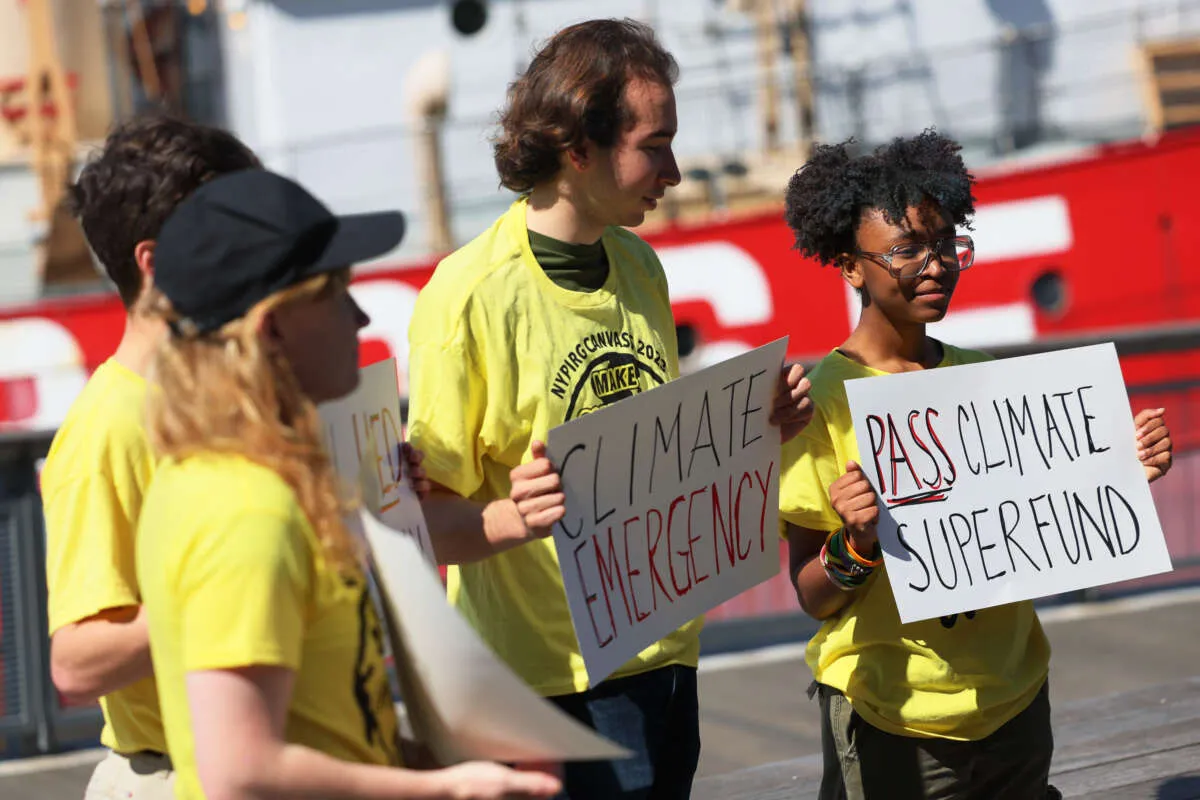
Democratic lawmakers in Minnesota have introduced legislation aimed at creating a climate “superfund” that would require large fossil fuel companies to help pay for damages associated with greenhouse gas emissions.
The proposed legislation, known as the Greenhouse Gas Pollution Superfund Act, seeks to hold major oil, gas and coal companies financially responsible for the environmental and economic impacts linked to their historic emissions.
The bill was introduced by Democratic state Senator Ann Johnson Stewart and Democratic state Representative Athena Hollins, who argue that communities across Minnesota are increasingly bearing the financial burden of climate-related damages.
Under the proposal, fossil fuel companies responsible for producing at least one billion metric tons of carbon emissions since 1995 would be required to pay fees reflecting their share of climate-related damage.
The revenue generated through these payments would be directed toward helping Minnesota communities adapt to the impacts of climate change, including funding infrastructure upgrades, disaster recovery efforts and public health initiatives.
Supporters say the legislation represents a new approach to climate accountability — shifting some of the costs associated with environmental damage away from taxpayers and toward the companies whose products contribute to greenhouse gas emissions.
Build the future you deserve. Get started with our top-tier Online courses: ACCA, HESI A2, ATI TEAS 7, HESI EXIT, NCLEX-RN, NCLEX-PN, and Financial Literacy. Let Serrari Ed guide your path to success. Enroll today.
How the Climate “Superfund” Model Works
The Minnesota proposal draws inspiration from the federal Superfund program created in 1980, which was designed to clean up hazardous waste sites across the United States.
Under the federal program, companies responsible for contaminating land with toxic waste are required to help fund environmental cleanup efforts.
Minnesota lawmakers are now proposing a similar framework to address climate change impacts.
Instead of focusing on toxic waste sites, the climate superfund would assess the costs associated with greenhouse gas emissions and require major fossil fuel producers to contribute to climate resilience and recovery programs.
If the bill were passed, the Minnesota State Auditor’s Office would be tasked with creating a formula to determine which companies are liable and how much each should contribute.
The calculation would rely on scientific data linking historical emissions to climate-related damage.
Once the funds are collected, the Minnesota Pollution Control Agency would oversee the administration of the program and manage the distribution of funding to local governments and infrastructure projects.
Representative Hollins said the proposed law is ultimately about accountability and fairness.
“Climate change is not a distant threat — it is a daily reality,” Hollins said during a press conference announcing the bill. “Our climate superfund bill is about accountability for this reality.”
She added that many communities suffering from climate-related damages are not the ones who benefited from decades of fossil fuel profits.
“We know that the Minnesotans who are most impacted by climate change are not the ones who profited,” Hollins said.
Addressing Growing Climate Infrastructure Costs
Supporters of the legislation argue that Minnesota is already facing rising costs associated with climate change, particularly in relation to infrastructure damage caused by extreme weather events.
According to Senator Johnson Stewart, the state has seen a significant increase in flooding and heavy rainfall events, which are placing growing pressure on infrastructure systems that were not designed for such conditions.
Local governments are increasingly being asked to fund costly upgrades to stormwater systems, bridges, dams and roads.
Johnson Stewart said the proposed superfund could help address these financial pressures.
The bill would allow funds collected from fossil fuel companies to support a wide range of climate-related projects, including:
- Upgrading sewer and stormwater systems to handle heavier rainfall
- Strengthening dams and flood control infrastructure
- Repairing public facilities damaged by extreme weather
- Supporting homeowners facing costly climate-related repairs
- Funding public health programs linked to pollution and extreme heat
Johnson Stewart pointed to the 2024 collapse of the Rapidan Dam near Mankato as an example of how climate-related events can strain infrastructure and create costly emergencies for local governments.
The senator, who is a civil engineer by profession, said Minnesota’s infrastructure systems were largely built for weather patterns that no longer reflect current climate conditions.
Environmental Impacts Already Visible Across Minnesota
Supporters of the bill also point to growing environmental changes occurring across Minnesota.
Scientists say the state is becoming warmer and wetter, resulting in more intense rainfall events and an increased risk of flash flooding.
These weather changes are already placing pressure on local infrastructure and public services.
At the same time, climate shifts have contributed to ecological challenges, including the spread of invasive species.
Minnesota is estimated to have roughly one billion ash trees, many of which are vulnerable to the pest.
The cost of removing dead trees, managing infestations and restoring affected landscapes has created financial challenges for both municipalities and property owners.
Johnson Stewart said these environmental changes are creating mounting costs that taxpayers are currently absorbing.
“We are suffering and every one of us is paying,” she said.
One decision can change your entire career. Take that step with our Online courses in ACCA, HESI A2, ATI TEAS 7, HESI EXIT, NCLEX-RN, NCLEX-PN, and Financial Literacy. Join Serrari Ed and start building your brighter future today
Republican Lawmakers and Business Groups Push Back
Despite support from Democratic lawmakers, the proposal has already drawn significant criticism from Republicans and business organizations.
Republican state Senator Andrew Mathews argued that the legislation could increase costs for Minnesota residents.
“Minnesotans are already struggling with rising costs of energy due to the actions of Democrats,” Mathews said in a statement. “The last thing they need is another complicated government program that will just raise the cost of gas and utilities.”
Opponents argue that if fossil fuel companies are forced to pay additional fees, those costs could ultimately be passed on to consumers through higher fuel and energy prices.
Business organizations have also raised concerns about the potential economic impact of the legislation.
The National Federation of Independent Business (NFIB) warned that the proposal could retroactively penalize companies for emissions that were legal at the time they occurred.
“At a time when Minnesota’s small businesses are already struggling with rising costs, our state cannot afford a policy that punishes reliable, affordable energy and sends the bill to Main Street businesses,” said NFIB Minnesota State Director Jon Boesche.
Critics say policies targeting fossil fuel companies could increase operating costs for businesses that depend heavily on energy, including manufacturing, transportation and agriculture.
Political Hurdles Could Delay the Legislation
Even some supporters of the bill acknowledge that it faces significant political challenges.
Minnesota currently has a split state government, making it difficult for legislation strongly backed by one political party to advance quickly.
Senator Johnson Stewart herself indicated that the bill may not pass during the current legislative session.
“I honestly don’t expect it to get passed this year. Our goal is to pass it next year,” she told the Minnesota Star Tribune.
The senator described the proposal as a long-term effort aimed at building support among lawmakers and raising awareness about climate accountability.
“This is obviously more of a Democrat bill,” she said.
Still, proponents believe the legislation could gain traction in future sessions as climate-related costs continue to rise.
Climate Superfund Laws Gaining Momentum Nationwide
Minnesota’s proposal is part of a broader national trend as several U.S. states explore new ways to fund climate resilience and environmental protection projects.
In May 2024, Vermont became the first state to pass a climate superfund law requiring fossil fuel companies to contribute to climate-related damages based on their historical emissions.
Later that year, New York Governor Kathy Hochul signed similar legislation into law aimed at funding environmental restoration projects and climate resilience efforts.
Supporters of these laws argue that they represent a logical extension of the federal Superfund model.
However, the legislation has sparked significant controversy.
Fossil fuel companies and industry groups argue that states may not have the authority to impose financial penalties based on global emissions.
The American Petroleum Institute (API) has criticized climate superfund policies, describing them as punitive measures targeting the energy industry.
“This type of legislation represents nothing more than a punitive new fee on American energy,” an API spokesperson said earlier this year in reference to New York’s law.
Legal challenges against the New York and Vermont laws are currently underway and could influence whether similar legislation in other states ultimately succeeds.
Outlook
The proposed Minnesota climate superfund reflects a broader shift in how governments are approaching the financial challenges associated with climate change.
As extreme weather events become more frequent and costly, state governments are increasingly searching for new funding mechanisms to support climate adaptation and resilience.
Climate superfund proposals represent one attempt to redistribute these costs by requiring fossil fuel companies to contribute to infrastructure repairs and environmental protection efforts.
However, the idea also raises complex questions about legal authority, economic impacts and the potential consequences for energy prices.
For supporters, the legislation represents a step toward holding major polluters accountable for the environmental consequences of their emissions.
For critics, it risks creating additional financial burdens that could ultimately be passed on to consumers and businesses.
Regardless of the bill’s immediate prospects, the debate surrounding Minnesota’s climate superfund highlights how climate policy discussions in the United States are increasingly shifting from emissions targets toward questions of financial responsibility.
As more states consider similar proposals, the outcome of ongoing legal battles and political negotiations will likely shape how climate-related costs are shared between governments, businesses and consumers in the years ahead.
Ready to take your career to the next level? Join our Online courses: ACCA, HESI A2, ATI TEAS 7 , HESI EXIT , NCLEX – RN and NCLEX – PN, Financial Literacy!🌟 Dive into a world of opportunities and empower yourself for success. Explore more at Serrari Ed and start your exciting journey today! ✨
Track GDP, Inflation and Central Bank rates for top African markets with Serrari’s comparator tool.
See today’s Treasury bonds and Money market funds movement across financial service providers in Kenya, using Serrari’s comparator tools.
Photo Source: Google
By: Rosemary Wambui
10th March 2026