
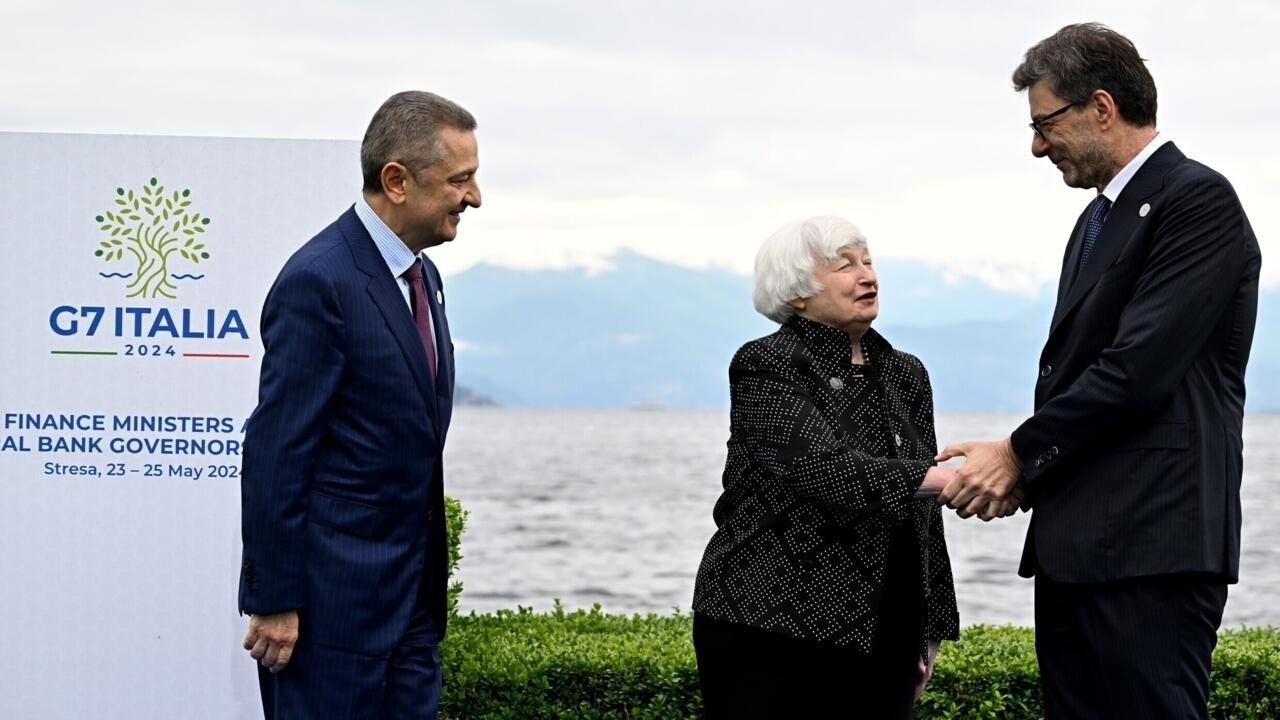
The G7 Finance Ministers and Central Bank Governors’ Meeting began on May 24, 2024, in Stresa, Italy, addressing critical issues such as financial support for Ukraine and responses to China’s industrial policies. Key attendees include Bank of Italy Governor Fabio Panetta, Canada’s Finance Minister Chrystia Freeland, and Italy’s Minister of Economy and Finance Giancarlo Giorgetti.
Financial Support for Ukraine
One of the summit’s primary topics is the proposal to provide a $50 billion loan to Ukraine, leveraging approximately $300 billion of frozen Russian assets. U.S. Treasury Secretary Janet Yellen indicated that while the loan could significantly aid Ukraine, the specifics have yet to be agreed upon due to legal and technical complexities.
French Finance Minister Bruno Le Maire expressed a need for efficient and prompt solutions, saying, “We will be putting a proposal to use the windfall profits from the Russian assets for the years to come. Let’s compare the proposals and see what is the most convenient.”
German Finance Minister Christian Lindner acknowledged that many questions remain unanswered, making an immediate decision unlikely. The G7 aims to advance these discussions ahead of the upcoming heads of government meeting in Puglia from June 13-15. Ukraine’s Finance Minister Serhiy Marchenko will join the discussions on Saturday to provide insights from his country.
Addressing China’s Industrial Policies
The summit also focuses on responding to China’s industrial practices and export dominance. Recently, the U.S. increased tariffs on various Chinese imports, including electric vehicle batteries and computer chips. While not urging its G7 partners to follow suit, Yellen stressed the importance of a unified stance.
France’s Le Maire highlighted the need to avoid a trade war while addressing issues such as unfair trade practices and industrial overcapacity. “A trade war is neither in the interest of the U.S., nor China, nor Europe,” he noted. “Nevertheless, we have an issue with the unfair trade practices, with the high level of subsidies, and with (China’s) industrial overcapacities.”
Italian Economy Minister Giancarlo Giorgetti suggested that Europe might eventually consider similar measures, reflecting a potential shift in the EU’s approach towards China. “The United States have taken very tough decisions and Europe will probably have to consider whether to do the same,” he commented.
Additional Discussions
The summit also covers efforts to revive talks on a global minimum tax for multinationals and a proposed global wealth tax on billionaires. Disagreements involving the U.S., India, and China have delayed the finalization of the global minimum tax deal initially planned for June.
Yellen expressed the U.S.’s reservations about the current global wealth tax proposal, despite France’s continued support. Le Maire emphasized France’s commitment, stating, “It is no longer acceptable for the wealthiest to escape taxation and everyone – everyone – must pay their fair share.”
As the G7 summit progresses, finance leaders aim to balance the urgent need for economic cooperation with the complexities of global politics, striving to develop cohesive strategies to address these significant challenges.
Photo source: Google
By: Montel Kamau
Serrari Financial Analyst
27th May, 2024